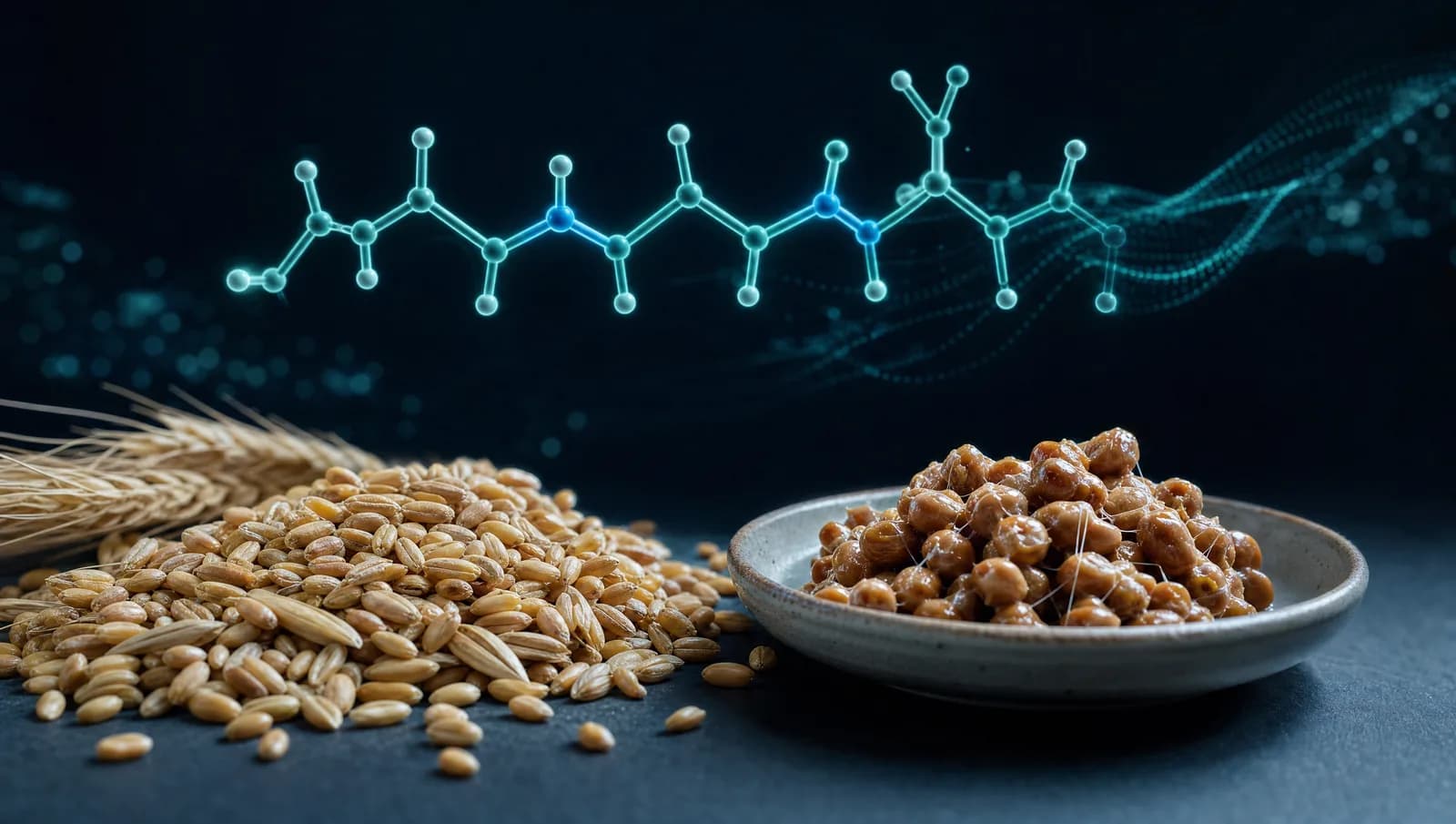
What spermidine actually does
Spermidine is a polyamine — a small, positively charged molecule present in every living cell and abundant in certain foods: wheat germ, aged cheeses, mushrooms, natto. Its claim to attention in longevity research is autophagy induction.
Autophagy is the cell’s recycling programme. Damaged proteins, worn-out mitochondria and general molecular debris are packaged and broken down for reuse. The rate of this housekeeping declines with age, and the accumulation of un-cleared material is one of the better-supported cellular hallmarks of aging.
The evidence base is mostly observational for humans — dietary intake correlated with outcomes in population studies — plus mechanistic work in cells and animals. It is a reasonable body of evidence, and notably it is about a process, not a symptom.
Where Bacillus F sits instead
The Bacillus F postbiotic does not induce autophagy and we do not claim it does. It is positioned earlier in the sequence: on the cell’s ability to withstand oxidative conditions in the first place.
The analogy that survives scrutiny is a building. Autophagy is the maintenance crew removing damaged fittings and replacing them. Oxidative resilience is closer to the quality of the materials — how much damage accumulates per unit of time, given the same environment.
Neither substitutes for the other. A building with excellent maintenance and terrible materials still degrades; excellent materials with no maintenance accumulate debris. This is why the two are usually discussed as complements rather than alternatives.
Head to head
The practical differences show up in sourcing, format and what kind of evidence exists for each.
| Spermidine | Bacillus F drops | |
|---|---|---|
| Mechanism | Induces autophagy (cellular clearance) | Oxidative-resilience metabolites |
| Source | Polyamine — wheat germ, aged cheese, natto | Fermented metabolites of a permafrost strain |
| Dietary route | Yes — food sources are meaningful | No dietary source exists |
| Evidence | Observational human data; animal and cell mechanism | Comet-assay imaging; patent and genome record |
| Format | Capsules or extract powder | Sublingual drops, 1 ml daily |
Food, supplements and dose
One honest point in spermidine’s favour: you can get meaningful amounts from food. Wheat germ is the densest common source, and a dietary approach costs almost nothing and carries no supplement-quality risk. If you are choosing between a spermidine capsule and adding wheat germ to breakfast, the food route is defensible.
That option does not exist for the Bacillus F metabolite fraction — there is no dietary source of an organism recovered from Siberian permafrost, which is precisely why it is sold as a preparation.
Where supplemental spermidine gets complicated is dose standardisation. Wheat-germ extracts vary substantially in polyamine content between suppliers, and labels are not always informative about the actual quantity.
Running both
There is no known interaction requiring separation, and the mechanisms do not overlap. A common arrangement is spermidine or wheat germ with a meal, and the drops sublingually in the morning.
The methodological caution applies as always: do not start both at once if you intend to learn anything. Add one, run 90 days against a baseline panel, then consider the second. Two simultaneous changes produce one uninterpretable result.