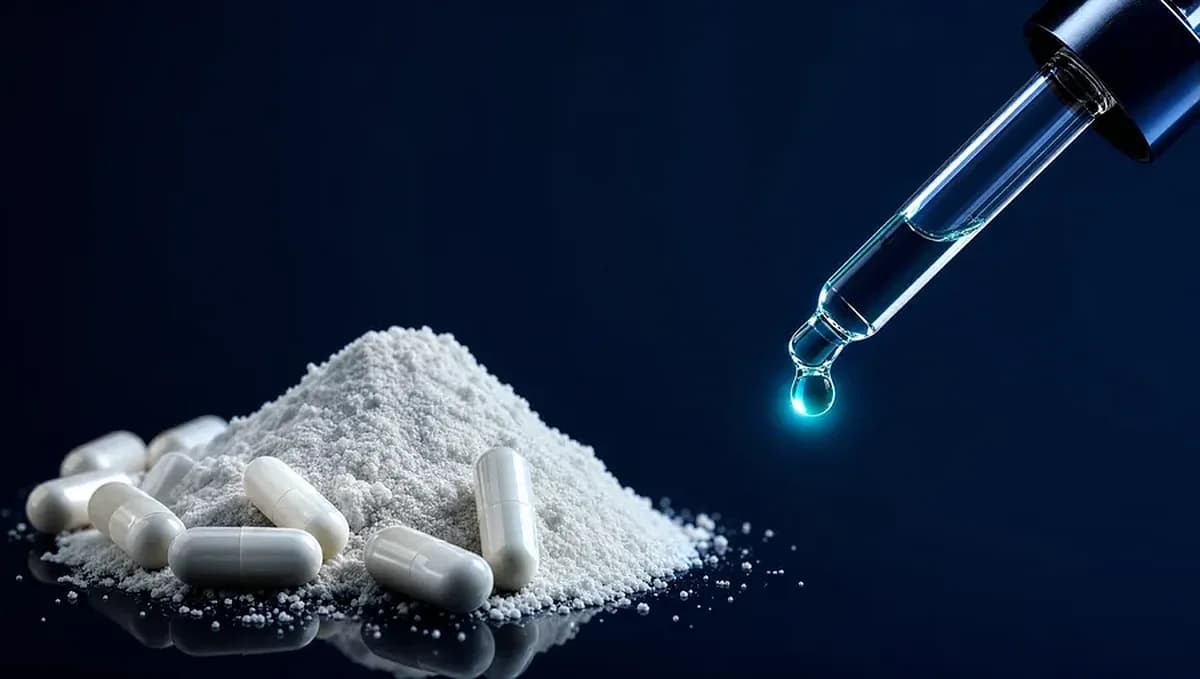
How NMN works
Nicotinamide mononucleotide is a precursor to NAD+, the coenzyme every cell uses to convert food into energy and to fuel repair enzymes such as sirtuins and PARPs. NAD+ levels fall with age — roughly halving between 20 and 50 — and NMN supplementation demonstrably raises them in blood.
What remains contested is the downstream effect. Human trials show improved insulin sensitivity in specific populations and modest gains in walking distance, but the dramatic lifespan results remain mouse-only. That gap between biomarker and outcome is why many long-term users eventually ask why they are still buying it.
How the Bacillus F postbiotic works
Bacillus F is a bacterium recovered viable from Siberian permafrost after an estimated three million years of dormancy. The supplement is a postbiotic: the stable metabolites the organism produces, separated from the cells. There are no live bacteria in the bottle.
Rather than raising a metabolic coenzyme, it is positioned on the cell’s resilience under oxidative conditions. The reference evidence is comet-assay imaging — fragmented DNA visibly streaming from untreated nuclei versus intact treated ones — published openly alongside patent WO2012060729.
Head to head
The two differ on nearly every axis that matters to a buyer — mechanism, evidence type, format, and regulatory position.
| NMN | Bacillus F drops | |
|---|---|---|
| Mechanism | Raises NAD+ (coenzyme precursor) | Oxidative-resilience metabolites |
| Evidence | Human trials on NAD+ levels; outcomes modest | Comet-assay DNA-integrity imaging; patent-documented strain |
| Format | Capsules/powder, daily | Sublingual drops, 1 ml daily |
| Stability | Generally stable; varies by supplier | Shelf-stable, no refrigeration |
| US retail status | Contested — FDA excluded it from supplements | Sold as a postbiotic supplement |
Can you take both?
Yes, and mechanistically it is a coherent pairing. NAD+-dependent repair enzymes are the cell’s responders to DNA damage; an oxidative-defence layer is aimed at reducing the damage those enzymes must address. One raises repair capacity, the other is positioned to lower the workload.
- Stacking: NMN in the morning for energy metabolism, drops sublingually per the 30-day protocol.
- Switching: common after an NMN plateau, or where NMN’s retail status is restricted.
- Starting fresh: if you take neither, start with one variable — you cannot attribute results to a stack.
Which should you choose?
If your goal is metabolic energy and you tolerate ambiguity about long-term outcomes, NMN is the established choice with the larger human literature. If your priority is documentation you can read yourself — patents, assay methodology, registration, safety sheet — the drops are built for exactly that reader.
Neither answer is universal, and anyone telling you otherwise is selling. The useful question is which mechanism your current protocol leaves uncovered.