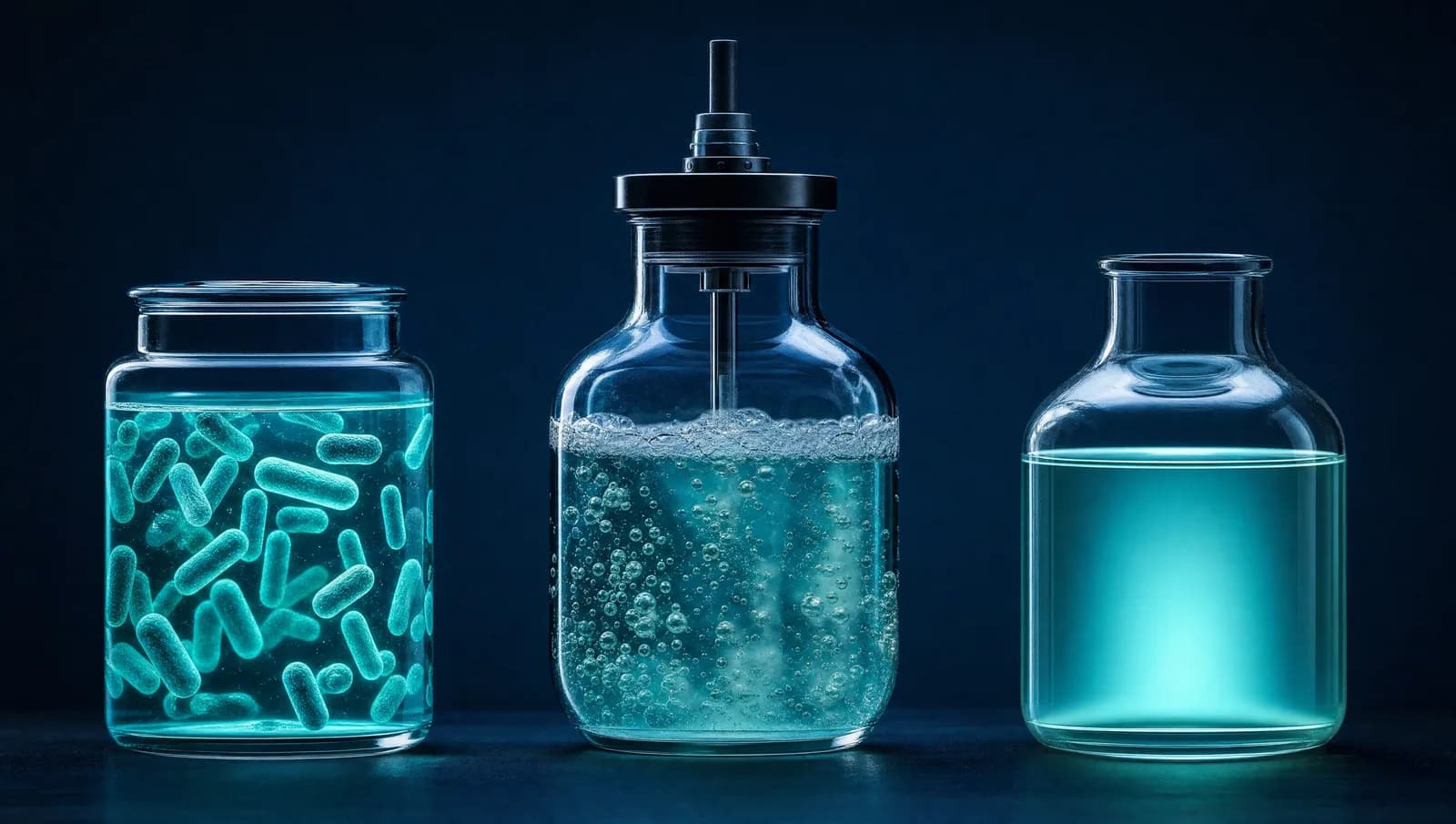
The three terms, distinguished
The vocabulary is confusing because the words were coined at different times by different fields, and marketing has since blurred them further. The distinction is actually simple.
- Probiotics: live microorganisms intended to confer a benefit when consumed in adequate amounts. Yoghurt cultures, multi-strain capsules, kefir.
- Prebiotics: substrates that feed beneficial organisms already present. Typically fibres: inulin, resistant starch, galacto-oligosaccharides.
- Postbiotics: the compounds produced by microorganisms during fermentation, delivered without the organisms. Metabolites, peptides, cell-wall fractions, enzymes.
Why the format matters
A probiotic has a delivery problem that is rarely stated plainly on the label. The organisms must survive manufacturing, survive the shelf, survive stomach acid, arrive in the intestine viable, and then establish themselves against an incumbent population that is already there and not especially welcoming.
Each of those is a loss point, and the losses are why live-culture products carry cold-chain requirements, colony-forming-unit counts that decline measurably across shelf life, and famously variable individual results.
A postbiotic has no delivery chain to fail. The useful molecules were produced under controlled conditions, separated, and stabilised. Nothing has to survive anything. The dose stated on the bottle is the dose that arrives.
Postbiotics are not automatically better
This is where we differ from most of the category, which treats "postbiotic" as a straightforward upgrade. It is not. It is a different tool for a different job.
If your goal is rebuilding gut flora after a course of antibiotics, you want live organisms, because repopulating requires something alive to do the repopulating. No postbiotic accomplishes that, and any brand implying otherwise is selling past the evidence.
Where postbiotics have the advantage is anywhere the target is a specific compound rather than a resident population, and anywhere reliability over a long protocol matters more than colonisation.
Fermentation-derived compounds are not new
There is nothing new about the underlying idea, which counts for it rather than against it. Human food cultures have relied on fermentation-derived compounds for millennia: miso, natto, koji, aged cheeses, sourdough, soy sauce. In each case what is valued is substantially what the organisms produced, not the organisms themselves.
What is new is the isolation and characterisation: identifying a specific metabolite fraction, documenting it, and delivering it at a consistent dose. That is an advance in manufacturing and analysis, not in concept.
Where Bacillus F fits
Our product is a postbiotic in the strict sense: the metabolite fraction of the Bacillus F strain, produced under controlled fermentation, separated from the cells, cold-processed into drops. There are no live organisms in the bottle and we say so on every page rather than leave you to work it out.
What follows from the format: no viability decline, the same chemistry batch to batch, and the same potency at day ninety as at day one. Ours is kept in the freezer until opened and in the fridge after, and that is the whole of the handling. For a daily habit meant to run for months, that kind of reliability is usually what decides whether the habit survives.
If a live culture is what you needed, better you hear it here than after you’ve paid.